Process

Process

Process

User flows/wireframes

Prototyping

User testing designs

Develop scalable design system + documentation

Competitors & Market Gaps

Feature Prioritization

Actionable Insights

Interview Analysis

Responsibilities

Design System + Documentation

Rapid Prototyping

Market Research

Visual Design + Branding

Interaction Design

Role

Lead UI Designer & PM

Project

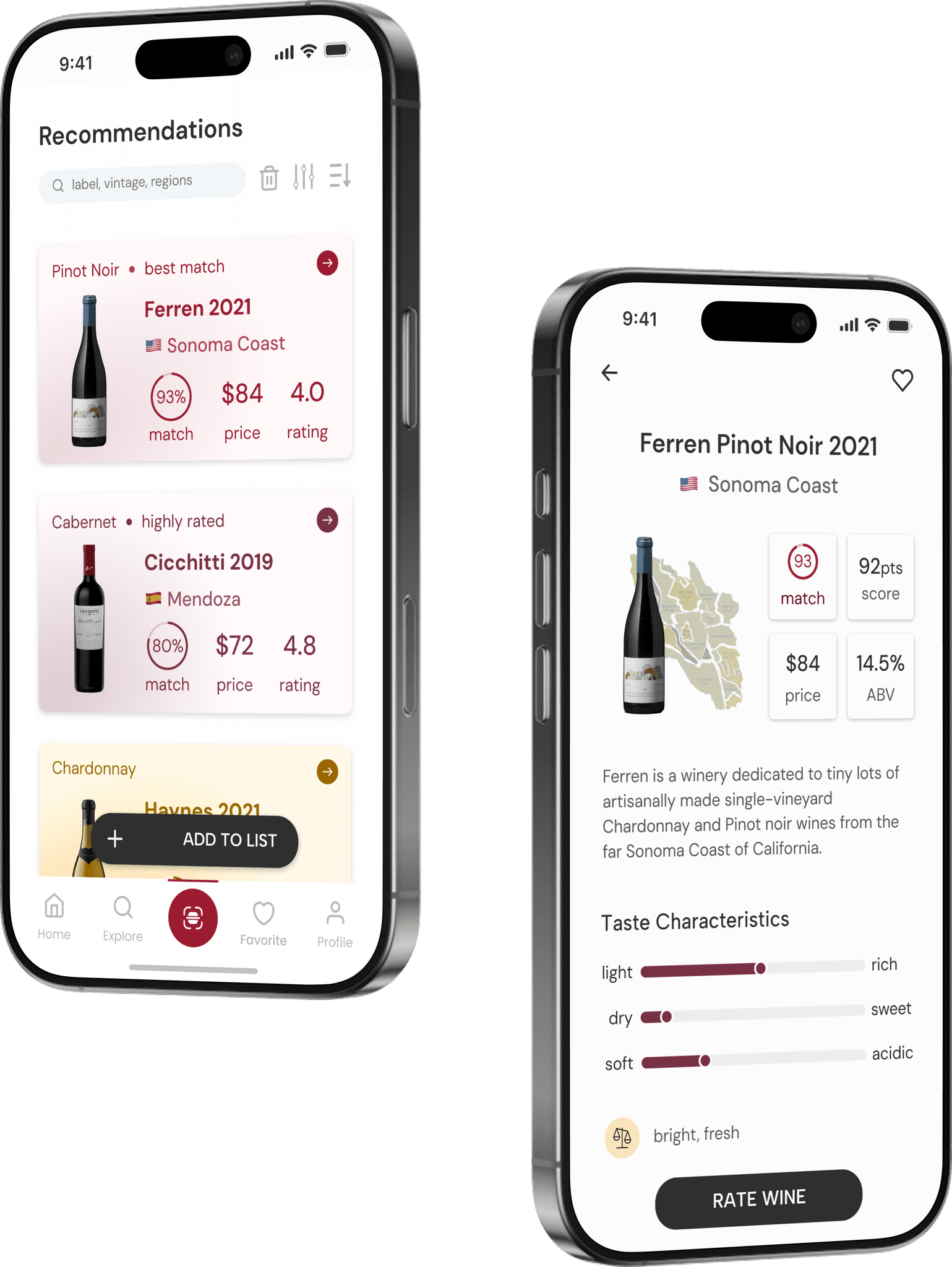
Wine App Concept

Wine App Concept

Wine App Concept

The wine industry is struggling—sales are plummeting, wineries are closing, and younger consumers aren’t engaging because buying wine feels like an expensive gamble. Confusing labels, critic-driven reviews, and an overwhelming number of choices leave buyers lost. By making wine selection effortless, transparent, and personalized, this app helps the industry reconnect with modern consumers and drive sales.

Challenge

Outcome

I designed an app concept that, with the right development and marketing, could attract an estimated 100,000 users in its first year. This would create new opportunities for wineries, restaurants, and distributors to boost sales and engagement, while helping revitalize a $400 billion industry facing declining consumer interest.
  • AN APP TO REVITALIZE A STRUGGLING BILLION-DOLLAR INDUSTRY

  • AN APP TO REVITALIZE A STRUGGLING BILLION-DOLLAR INDUSTRY

  • AN APP TO REVITALIZE A STRUGGLING BILLION-DOLLAR INDUSTRY

  • AN APP TO REVITALIZE A STRUGGLING BILLION-DOLLAR INDUSTRY

How the Wine Industry Works Against Itself and My Pitch to Solve It

Critics can shape what wines get made based on their personal preferences—not necessarily consumer taste. A wine you’d love might score poorly, while an overpriced bottle gets top marks. Meanwhile, confusing labels and overwhelming choices keep buyers lost, leaving wine stuck in an analog, word-of-mouth industry.

I pitched this app to shift the power back to consumers, making wine selection intuitive, transparent, and free from industry bias.

Critics can shape what wines get made based on their personal preferences—not necessarily consumer taste. A wine you’d love might score poorly, while an overpriced bottle gets top marks. Meanwhile, confusing labels and overwhelming choices keep buyers lost, leaving wine stuck in an analog, word-of-mouth industry.

I pitched this app to shift the power back to consumers, making wine selection intuitive, transparent, and free from industry bias.

Vivino is a major competitor, but its approach lacks personalization and flexibility. This app goes beyond static ratings, offering:

More precise user preferences — adjustable to reflect individual taste

An evolving algorithm — wine ratings refine recommendations over time

A friends feature — see what people you know enjoy (or buy wine for them)

Side-by-side comparisons — choose between wines

Archetype reviews — see opinions from users with a similar palate

By focusing on user freedom and dynamic personalization, this app creates a tailored, data-driven wine experience—free from bias and guesswork.

Beyond Ratings: A Smarter, More Personalized Wine Experience

More Use Cases, More Problems: The Challenge of Expanding Features Late in the Game

The original goal was to help users navigate restaurant wine lists, but as the design evolved, so did its use cases.

A label-scanning feature was a seamless addition, allowing users to browse stores or screenshot wines online.

A search function felt essential—but integrating it into the comparison flow proved difficult.

With only three days left, I included search into the explore screen, but in hindsight, the rushed addition left user flow and design from the home screen feeling unfinished. It reinforced the importance of balancing feature expansion with cohesive, intentional design.

Potential Impact

Potential Impact

Potential Impact

The $400 billion global wine industry is struggling to engage Millennials and Gen Z, who are overwhelmed by selection and disengaged from traditional marketing.

The app could help 10,000+ U.S. wineries reach younger consumers by making wine selection more accessible and data-driven. Based on market research, this app has the potential to gain 100,000+ users in Year 1, a 3% conversion rate, and a $0.99 per download model, it could generate $99K+ in revenue, with potential for premium features and B2B partnerships.Restaurants, wineries, and wine retailers benefit from more confident buyers, increased sales, and deeper consumer engagement.

This app isn’t just about helping consumers choose wine—it’s about modernizing an industry stuck in the past.

The $400 billion global wine industry is struggling to engage Millennials and Gen Z, who are overwhelmed by selection and disengaged from traditional marketing.

The app could help 10,000+ U.S. wineries reach younger consumers by making wine selection more accessible and data-driven. Based on market research, this app has the potential to gain 100,000+ users in Year 1, a 3% conversion rate, and a $0.99 per download model, it could generate $99K+ in revenue, with potential for premium features and B2B partnerships.Restaurants, wineries, and wine retailers benefit from more confident buyers, increased sales, and deeper consumer engagement.

This app isn’t just about helping consumers choose wine—it’s about modernizing an industry stuck in the past.

The $400 billion global wine industry is struggling to engage Millennials and Gen Z, who are overwhelmed by selection and disengaged from traditional marketing.

The app could help 10,000+ U.S. wineries reach younger consumers by making wine selection more accessible and data-driven. Based on market research, this app has the potential to gain 100,000+ users in Year 1, a 3% conversion rate, and a $0.99 per download model, it could generate $99K+ in revenue, with potential for premium features and B2B partnerships.Restaurants, wineries, and wine retailers benefit from more confident buyers, increased sales, and deeper consumer engagement.

This app isn’t just about helping consumers choose wine—it’s about modernizing an industry stuck in the past.

The $400 billion global wine industry is struggling to engage Millennials and Gen Z, who are overwhelmed by selection and disengaged from traditional marketing.

The app could help 10,000+ U.S. wineries reach younger consumers by making wine selection more accessible and data-driven. Based on market research, this app has the potential to gain 100,000+ users in Year 1, a 3% conversion rate, and a $0.99 per download model, it could generate $99K+ in revenue, with potential for premium features and B2B partnerships.Restaurants, wineries, and wine retailers benefit from more confident buyers, increased sales, and deeper consumer engagement.

This app isn’t just about helping consumers choose wine—it’s about modernizing an industry stuck in the past.

Let's Connect!

Let's Connect!

Let's Connect!

Want to chat about gritty design details, product strategy, or my latest work?

Want to chat about gritty design details, product strategy, or my latest work?

Want to chat about gritty design details, product strategy, or my latest work?

Want to chat about gritty design details, product strategy, or my latest work?

© Eleanor Shepard 2024. All Rights Reserved.

© Eleanor Shepard 2024. All Rights Reserved.

Eleanor Shepard

Eleanor Shepard